
Steps to Miles Calculator
Turn any step count into miles or kilometers in a couple of seconds. Type in your steps, pick walking or running, add your height, and the calculator estimates your distance, time and calories. If you have ever looked at a watch that says 9,400 steps and wondered whether that was a short stroll or a proper hike, this page answers it. Everything runs inside your browser, so nothing is uploaded and no account is needed. Curious about the most famous target? Read our guide to how far 10,000 steps really is, or learn how your stride length relates to height.
Quick facts about steps and miles
- 10,000 steps is about 4 to 5 miles for most adults, depending on height.
- Walking usually takes 2,000 to 2,500 steps per mile.
- Running usually takes 1,400 to 1,800 steps per mile.
- Walking stride is roughly 41.5% of your height.
- Running stride is roughly 52% of your height.
- Taller people need fewer steps to cover a mile.
Calculate your distance
Estimates use population-average stride ratios. Calculator formulas last reviewed in 2026.
Steps to miles at a glance
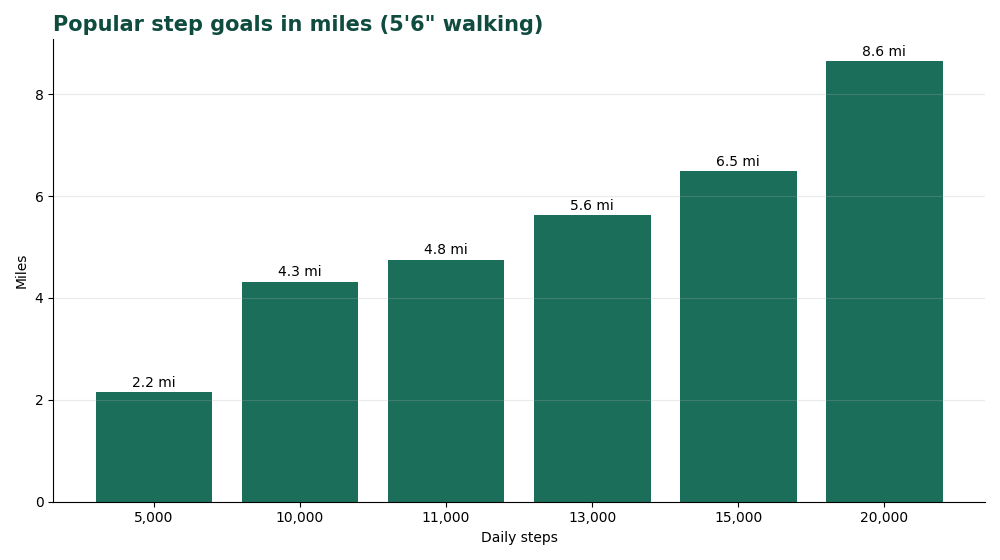
These conversions use the average stride of a 5’6″ adult. They are a handy starting point when you do not want to open the calculator.
| Steps | Walking miles | Walking km | Running miles | Running km |
|---|---|---|---|---|
| 5,000 | 2.2 mi | 3.5 km | 2.7 mi | 4.4 km |
| 10,000 | 4.3 mi | 7.0 km | 5.4 mi | 8.7 km |
| 11,000 | 4.8 mi | 7.7 km | 6.0 mi | 9.6 km |
| 13,000 | 5.6 mi | 9.0 km | 7.0 mi | 11.3 km |
| 15,000 | 6.5 mi | 10.4 km | 8.1 mi | 13.1 km |
| 20,000 | 8.6 mi | 13.9 km | 10.8 mi | 17.4 km |
Steps per mile by height
Height drives stride, and stride drives how many steps a mile takes. Find your row below to see how your own numbers compare with the average.
| Height | Walking stride | Steps per mile (walking) | Running stride | Steps per mile (running) |
|---|---|---|---|---|
| 5’0″ | 24.9 in | 2,545 | 31.2 in | 2,031 |
| 5’2″ | 25.7 in | 2,462 | 32.2 in | 1,965 |
| 5’4″ | 26.6 in | 2,386 | 33.3 in | 1,904 |
| 5’6″ | 27.4 in | 2,313 | 34.3 in | 1,846 |
| 5’8″ | 28.2 in | 2,245 | 35.4 in | 1,792 |
| 5’10” | 29.0 in | 2,181 | 36.4 in | 1,741 |
| 6’0″ | 29.9 in | 2,120 | 37.4 in | 1,692 |
| 6’2″ | 30.7 in | 2,063 | 38.5 in | 1,647 |
| 6’4″ | 31.5 in | 2,009 | 39.5 in | 1,603 |
Calibration idea: if your watch reports a very different steps-per-mile figure from this table, walk a quarter-mile track at a normal pace, count the steps, and compare. A big gap usually means your device’s stride setting needs adjusting.
Miles to steps for popular distances
Planning a charity walk or a 5K? Use this table to see roughly how many steps each distance takes, by height.
| Distance | Steps (5ft 4in walking) | Steps (5ft 8in walking) | Steps (6ft 0in walking) | Steps (5ft 8in running) |
|---|---|---|---|---|
| 1 mile | 2,386 | 2,245 | 2,120 | 1,792 |
| 2 miles | 4,771 | 4,490 | 4,241 | 3,584 |
| 3 miles | 7,157 | 6,736 | 6,361 | 5,376 |
| 5K (3.1 mi) | 7,412 | 6,976 | 6,588 | 5,567 |
| 5 miles | 11,928 | 11,226 | 10,602 | 8,959 |
| 10K (6.2 mi) | 14,824 | 13,952 | 13,177 | 11,135 |
| Half marathon | 31,272 | 29,433 | 27,797 | 23,489 |
| Marathon | 62,547 | 58,867 | 55,597 | 46,981 |
The formulas behind the calculator
The tool follows a short chain of arithmetic. If you like to see the working, our steps to miles formula guide goes deeper. Here is the core of it.
Main conversion
Miles = (steps × stride in feet) ÷ 5,280
Multiply your steps by the length of one stride in feet to get total feet traveled, then divide by the 5,280 feet in a mile.
Estimating stride from height
Walking stride = height × 0.415 and running stride = height × 0.52
Running strides are about a quarter longer because both feet leave the ground between steps.
Reverse conversions
Steps = (miles × 5,280) ÷ stride in feet converts a distance goal into steps. Steps per mile = 5,280 ÷ stride in feet gives your personal ratio.
Worked example
Take someone who is 5’10” (70 inches) and logs 8,000 walking steps.
- Walking stride: 70 × 0.415 = 29.0 inches, or 2.42 feet.
- Distance in feet: 8,000 × 2.42 = 19,367 feet.
- Miles: 19,367 ÷ 5,280 = 3.67 miles.
- Kilometers: 3.67 × 1.60934 = 5.90 km.
Tip: for the sharpest results, measure your real stride. Walk 20 normal steps on level ground, measure the total distance, divide by 20, and choose the custom stride option.
Extra estimates and constants
| Estimate | Formula | Note |
|---|---|---|
| Calories, walking | Steps × 0.04 | Rough; depends on body weight |
| Calories, running | Steps × 0.06 | Rough; depends on effort |
| Time, walking | Miles ÷ 3 mph | Assumes a moderate pace |
| Time, running | Miles ÷ 6 mph | About a 10-minute mile |
| Kilometers | Miles × 1.60934 | Standard conversion |
How to read your results
The calculator returns several numbers. Here is what each one tells you.
Distance
This is estimated ground covered. Two people with the same step count can travel different distances because their strides differ. As a loose guide, 1 to 2 miles is a short outing, 3 to 4 miles is about an hour of steady walking, and 5 miles or more is a big day.
Steps per mile
Most adults land between 2,000 and 2,500 walking steps per mile. A higher figure points to a shorter stride; a lower one suggests longer legs or a running gait. Our steps per mile chart lists values for every common height.
Calories
The calorie figure is a rough average per step. Body weight, pace, hills and fitness all move the real number, so treat it as a ballpark rather than a measurement.
Time
Time assumes 3 mph for walking and 6 mph for running. A slow stroll or a hilly route will take longer.
Progress toward 10,000
The bar compares your steps with the familiar 10,000-step target. That number began as a Japanese pedometer slogan in the 1960s rather than a medical threshold, yet studies since then show benefits rising up to roughly 7,500 to 10,000 steps a day. Even 4,000 to 5,000 steps beat a mostly seated day.
Stride length
Your stride should be near 41 to 42% of your height when walking and about 50 to 52% when running. If it is far outside that range and you have pain when walking, a physical therapist can check your gait.
Step counting versus GPS tracking
Devices measure distance in two ways: they count steps and multiply by stride, or they follow satellites. Each has strengths.
| Feature | Step-based | GPS-based |
|---|---|---|
| Method | Counts steps, multiplies by stride | Tracks position by satellite |
| Indoors | Works on treadmills and in malls | Weak or no signal |
| Outdoor accuracy | Usually within 5 to 15% | Usually within 1 to 3% |
| Battery use | Very low | High |
| Best for | Daily activity and step goals | Routes, pace and races |
| Winding paths | Unaffected by path shape | Can cut corners in poor signal |
Choose steps for everyday tracking, indoor workouts and general health goals. Choose GPS for race pacing and route mapping. Use both if you want accurate routes plus a full-day activity total.
How to use the three tabs
Steps to Miles
- Enter your steps or tap a quick-select button.
- Pick Walking or Running. Anything with a flight phase counts as running, even a gentle jog.
- Choose whether to estimate stride from height or enter your own stride.
- Press Calculate to see miles, kilometers, calories, time and progress toward 10,000 steps.
Miles to Steps
- Enter a distance and choose miles or kilometers.
- Set activity and stride the same way.
- Press Calculate to see the steps required and how that compares with a 10,000-step day.
Steps per Mile
- Select walking or running and enter height or stride.
- Press Calculate to see steps per mile and per kilometer, with a by-height reference table underneath.
Getting more accurate results
- Measure a real stride instead of relying on the height estimate.
- Use running mode only when you are actually running.
- Remember the default height is 5’6″, so enter your own.
- Expect uphill, trail and crowded-street walking to shorten your stride.
Mistakes to avoid
- Mixing up walking and running modes can shift results by about 25%.
- Forgetting to change the default height.
- Using running mode for fast walking.
- Expecting an exact match with GPS; a gap of 5 to 10% is normal.
Real-world examples
Here are eight everyday situations, each worked out with the formulas above.
Example 1: a day of errands
Priya is 5’3″ and her phone shows 7,500 steps after a shopping day. Her walking stride is 26.1 inches, so she covered about 3.09 miles (4.98 km), which is 75% of a 10,000-step day.
Example 2: a trail run
Omar is 6’1″ and logged 6,500 running steps. With a running stride of 38.0 inches he ran roughly 3.89 miles. Taller runners need fewer steps for the same distance.
Example 3: exactly 10,000 steps
Hannah is 5’7″. Her 10,000 walking steps equal 4.39 miles (7.06 km), about an hour and a half at a relaxed pace.
Example 4: the morning dog walk
Ken is 5’11” and walks his dog twice a day, about 2,400 steps each time. That is 4,800 steps, or 2.23 miles of daily distance before he even starts his workday.
Example 5: gentle recovery walking
Margaret is 5’1″ and building stamina after surgery with her doctor’s approval. Her 5,000 steps equal 2.00 miles. She uses the number to track progress week by week.
Example 6: a charity walk
Diego is 5’9″ and registered for a 6-mile fundraiser. Using the Miles to Steps tab, he needs about 13,276 steps to finish.
Example 7: run/walk intervals
Fatima is 5’5″. She ran 3,500 steps (1.87 miles) and walked 4,500 steps (1.92 miles), for a total of 3.78 miles.
Example 8: a campus day
Sam is 5’10” and tracks 14,000 steps between lectures, the library and the gym. That works out to 6.42 miles (10.33 km), well beyond the common daily target.
When this calculator helps
- Translating tracker data. Convert steps into the miles or kilometers you actually think in.
- Setting goals. Pick a distance, such as 3 miles a day, and see the matching step target.
- Checking device accuracy. Compare a measured walk with the estimate to spot a miscalibrated tracker.
- Planning routes. Maps give distance; this tool gives the likely step count.
- Understanding guidelines. Bridge advice given in steps with advice given in minutes or miles.
- Tracking progress. Express weekly and monthly totals in miles for easy milestones.
- Comparing walking and running. See why a run logs fewer steps than a walk of equal length.
- Treadmill cross-checks. Match the machine’s distance display with your step count.
Who gets the most value
- People starting a walking routine.
- Runners studying cadence and stride.
- Anyone following a clinician’s activity advice.
- Office workers curious about their hidden daily mileage.
- Anyone who simply wonders how far they have gone.
Step goal ladder
Each popular goal translates to a different distance for a 5’6″ walker:
- 10,000 steps: about 4.3 miles
- 11,000 steps: about 4.8 miles
- 13,000 steps: about 5.6 miles
- 15,000 steps: about 6.5 miles
- 20,000 steps: about 8.6 miles
Open a goal to see the full breakdown by height and fitness level.
Related guides
- How Many Miles Is 10,000 Steps? The 10K goal explained.
- How Many Steps in a Mile? Averages by pace and height.
- Steps per Mile Chart A full reference table.
- Steps to Miles Formula The math, step by step.
- Stride Length by Height Estimate and measure your stride.
- Miles to Steps Calculator Guide Distances to step targets.
- 11,000 Steps to Miles
- 13,000 Steps to Miles
- 15,000 Steps to Miles
- 20,000 Steps to Miles
Frequently asked questions
How many miles is 10,000 steps?
For most adults 10,000 steps is between 4 and 5 miles when walking. A 5’4″ walker covers about 4.2 miles and a 6’0″ walker about 4.7 miles. See the full 10,000 steps guide.
How many steps are in a mile?
Walking averages 2,000 to 2,500 steps per mile and running averages 1,400 to 1,800. The steps in a mile guide breaks this down by height and speed.
How do I measure my stride length?
Walk 20 steps at a natural pace on flat ground, measure the distance from your first footprint to your last, and divide by 20. You can enter the result as a custom stride.
Why does running change the result?
Running adds a flight phase, so each step travels farther. Running stride is about 25% longer than walking stride, which means the same step count covers more ground.
Is 10,000 steps a day necessary for health?
No. Research shows gains rising up to about 7,500 to 10,000 daily steps, and meaningful benefits begin much lower. The best target is one you can sustain and gradually raise.
How accurate is this calculator?
It is as accurate as the stride estimate behind it. Expect a 5 to 10% difference from GPS. Entering a measured stride length tightens the estimate.
Which formula is used?
Miles equals steps multiplied by stride length in feet, divided by 5,280. Stride is estimated from height unless you supply your own. See the formula guide.
Should I speak to a doctor before changing my activity?
If you have a medical condition, are returning from injury, or are unsure, check with a healthcare professional. This calculator gives estimates and is not medical advice.
How does height change steps per mile?
Taller people take longer strides, so they need fewer steps. Walking at 5’0″ is about 2,545 steps per mile, while at 6’4″ it is about 2,008.
Does it work for treadmills?
Yes. Step counts stay reliable indoors where GPS cannot track movement, so this is a good way to sanity-check a treadmill display.