
Quick answer: 20,000 steps equals about 8.4 to 9.4 miles when walking, depending on height. It is double the standard goal and more of a lifestyle than a daily target.
Key takeaway: at 5’8″, 20,000 walking steps cover 8.91 miles (14.34 km), take about 2 h 58 min at 3 mph, and burn roughly 755 kcal for a 160 lb walker.
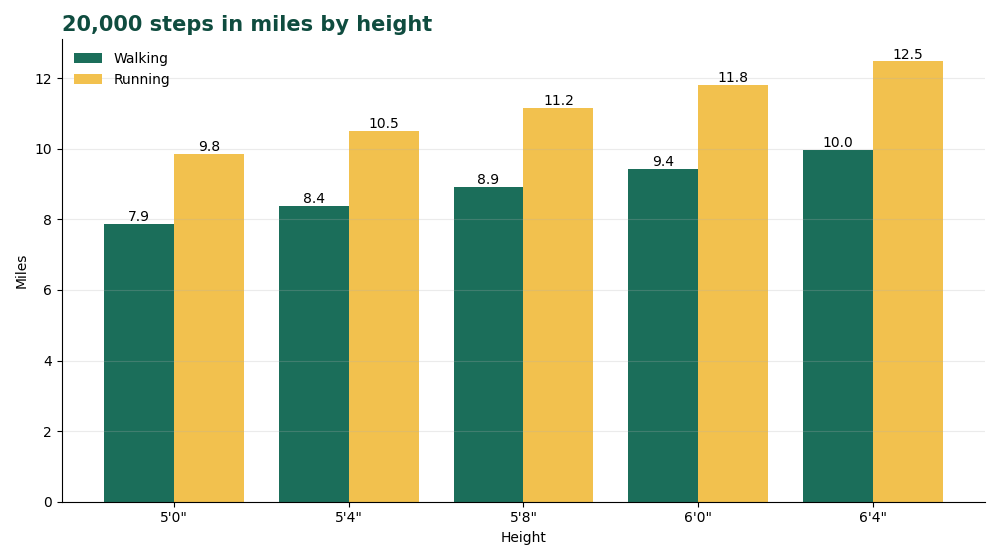
20,000 steps in miles by height
Stride length is mostly a function of height, so the same step count translates to different distances. The table uses a walking stride of 41.5% of height and a running stride of 52%.
| Height | Walking miles | Walking km | Running miles | Running km |
|---|---|---|---|---|
| 5’0″ | 7.86 | 12.65 | 9.85 | 15.85 |
| 5’4″ | 8.38 | 13.49 | 10.51 | 16.91 |
| 5’6″ | 8.65 | 13.91 | 10.83 | 17.43 |
| 5’8″ | 8.91 | 14.34 | 11.16 | 17.96 |
| 5’10” | 9.17 | 14.76 | 11.49 | 18.49 |
| 6’0″ | 9.43 | 15.18 | 11.82 | 19.02 |
| 6’2″ | 9.69 | 15.60 | 12.15 | 19.55 |
Want your own number? Enter your height or measured stride in the steps to miles calculator.
How the conversion works
The math is simple: multiply steps by stride length in feet and divide by 5,280. For a 5’8″ person, the walking stride is 28.2 inches (2.35 feet), so 20,000 steps cover 47,033 feet, which is 8.91 miles. The steps to miles formula guide explains each term, and the stride length chart helps you find your own.
Who walks 20,000 steps a day?
Twenty thousand steps works out to roughly 8.5 to 10 miles for most adults, which is close to a four-hour walk at a steady pace. Hikers, tourists on city-break days, postal and delivery workers, nurses on busy wards and event staff regularly hit it. For most others it is an occasional big day rather than a routine.
Benefits from walking tend to flatten beyond roughly 10,000 to 12,000 steps for the general population, so 20,000 is not necessary for health. It can still be a satisfying challenge for people who enjoy long walks, training for a hike or following a high-activity lifestyle.
How long does it take?
Time depends on pace and how continuous the walking is. The figures below assume a 5’8″ walker covering 8.91 miles.
| Pace | Speed | Time for 20,000 steps (5’8″) |
|---|---|---|
| Easy | 2.5 mph | 3 h 34 min |
| Moderate | 3.0 mph | 2 h 58 min |
| Brisk | 3.5 mph | 2 h 33 min |
| Power walk | 4.0 mph | 2 h 14 min |
At a moderate pace this is about four hours of walking in total. Brisk or power walking can bring it nearer three, but most people complete it in several blocks.
Calories burned
Energy use rises with body weight, speed and hills. These are level-ground estimates, so treat them as ballpark figures.
| Body weight | Easy pace (kcal) | Brisk pace (kcal) |
|---|---|---|
| 130 lb | 614 | 764 |
| 160 lb | 755 | 941 |
| 190 lb | 897 | 1,117 |
| 220 lb | 1,039 | 1,293 |
Planning a 20,000-step day
- Start early: one long walk of 90 minutes gives roughly 9,000 to 10,000 steps.
- Schedule rest breaks: sit for ten minutes every couple of hours and refuel.
- Pick comfortable routes: parks and paths are kinder to joints than long stretches of concrete.
- Carry water and a snack for anything beyond an hour.
- Use music or audiobooks to make long walks fly by.
Weekly and monthly impact
Consistency turns a daily habit into serious mileage.
| Measure | Daily | Weekly | 30 days |
|---|---|---|---|
| Steps | 20,000 | 140,000 | 600,000 |
| Distance (5’8″ walking) | 8.9 mi | 62.4 mi | 267 mi |
| Distance in km | 14.3 km | 100 km | 430 km |
Recovery and risk management
Very high step counts load the feet, calves and hips. Increase gradually over several weeks, replace shoes before they wear out, and take a lighter day afterward. Blister prevention, sun protection and hydration are practical must-haves. Stop and seek advice if you notice sharp pain, swelling, chest discomfort or dizziness. Check with a healthcare professional before attempting a big jump in activity, especially if you have medical conditions.
How 20,000 steps compares with other goals
| Goal | Walking distance (5’6″) | Compared with 10,000 |
|---|---|---|
| 5,000 | 2.2 mi | 50% |
| 10,000 | 4.3 mi | 100% |
| 11,000 | 4.8 mi | 110% |
| 13,000 | 5.6 mi | 130% |
| 15,000 | 6.5 mi | 150% |
| 20,000 | 8.6 mi | 200% |
See the neighbors: 15,000 steps and 10,000 steps. The overall conversion is explained in the 10,000 steps guide, and the full table of ratios sits in the steps per mile chart.
Frequently asked questions
How far is 20,000 steps in miles?
About 8.4 miles at 5’4″, 8.9 miles at 5’8″ and 9.4 miles at 6’0″ when walking.
How many calories does 20,000 steps burn?
Approximately 700 to 1,000 kcal for a 160 lb walker, depending on pace and terrain.
Is 20,000 steps a day too much?
It is a lot for most people. Active workers and keen walkers may do it regularly, but health benefits level off well below this number.
How long does it take to walk 20,000 steps?
Around four hours in total at a moderate pace.
Conclusion
Twenty thousand steps is roughly 8.5 to 10 miles: an ambitious target for hikers and highly active workers. Build up slowly, plan breaks and recovery, and use the calculator to turn your step count into distance.
This guide is for general information and is not medical advice.
Related guides
Try the free steps to miles calculator for your own height and stride.