
Short answer: 10,000 steps comes to roughly 4 to 5 miles (about 6.5 to 8 kilometers) for most adults. Your own figure moves with your stride, which mostly depends on height and on whether you are walking or running. This guide shows the exact distance for each height, how long it takes, what it burns, where the number came from, and how to build up to it safely.
What’s inside
- Distance by height
- The formula
- Where 10,000 came from
- What the research says
- Time and calories
- How to reach the goal
- Tracking accuracy
- Plans by fitness level
- FAQ
Key takeaway: a 5’8″ walker covers about 4.5 miles in 10,000 steps, which takes roughly 89 minutes at 3 mph. You do not have to do it in one session.
10,000 steps in miles, by height
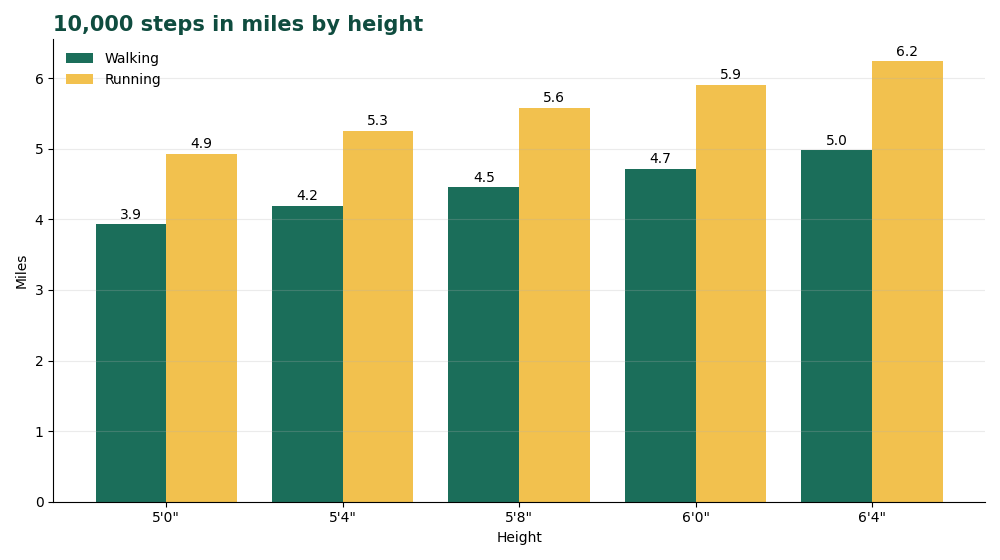
Longer legs mean longer strides, so taller people travel farther on the same number of steps. These values use a walking stride of 41.5% of height and a running stride of 52%.
| Height | Walking miles | Walking km | Running miles | Running km |
|---|---|---|---|---|
| 5’0″ | 3.93 | 6.32 | 4.92 | 7.92 |
| 5’4″ | 4.19 | 6.75 | 5.25 | 8.45 |
| 5’6″ | 4.32 | 6.96 | 5.42 | 8.72 |
| 5’8″ | 4.45 | 7.17 | 5.58 | 8.98 |
| 5’10” | 4.58 | 7.38 | 5.74 | 9.25 |
| 6’0″ | 4.72 | 7.59 | 5.91 | 9.51 |
| 6’2″ | 4.85 | 7.80 | 6.07 | 9.77 |
For a personalized result, open the steps to miles calculator and enter your own height or measured stride.
The formula behind the numbers
Miles = (steps × stride in feet) ÷ 5,280. Multiply the steps by the length of one stride, then divide by the feet in a mile. Our formula guide walks through variations.
Estimating your stride
Without a measurement, multiply height in inches by 0.415 for walking or 0.52 for running. At 5’8″ (68 inches) that gives 28.2 inches walking, so 10,000 steps cover 23,517 feet, or 4.45 miles. You can look up more heights in the stride length chart.
Measuring your real stride
- Choose a flat, clear stretch.
- Mark a start line and walk 20 natural steps.
- Measure from the start line to your last footprint.
- Divide by 20.
Real strides vary with speed, shoes and terrain, so a measured value beats the estimate whenever you have one. See also: how many steps are in a mile.
Where the 10,000 figure came from
The target was not handed down by a medical panel. In the mid-1960s, a Japanese company marketed a pedometer called Manpo-kei, which means “10,000 steps meter.” The round, memorable number appeared around the time of the 1964 Tokyo Olympics, when interest in fitness was high. It stuck, then spread around the world through fitness gadgets and workplace wellness programs.
What the research says today
Researchers have since tested whether more steps really do help. The picture is encouraging, though 10,000 is not a magic line.
- A large study of older women found that those averaging about 4,400 steps a day had lower death rates than those averaging about 2,700, with benefits leveling off near 7,500.
- Analyses of adult cohorts report that risk keeps falling as steps rise, with gains flattening somewhere around 8,000 to 12,000 for people under 60.
- A pooled analysis published in a Lancet journal suggested the sweet spot is about 6,000 to 8,000 steps for adults over 60 and 8,000 to 10,000 for younger adults.
The practical message: more is generally better up to a point, and the first few thousand steps matter most. Reaching 10,000 is a fine goal, not a pass-or-fail test.
Health benefits of a 10,000-step day
Heart and circulation
Regular walking is linked with healthier blood pressure, better cholesterol balance and a lower resting heart rate over time. It also supports blood sugar control after meals, which is why a short walk after dinner is so popular.
Weight management
The energy cost of 10,000 steps is modest but adds up. Over a week it can equal several hundred extra kilocalories per day, enough to support a calorie gap when combined with sensible eating.
Mood and sleep
Walkers often report lower stress, better mood and deeper sleep. Daylight and fresh air amplify the effect, so outdoor routes tend to feel more restorative.
Joints, muscles and bones
Walking is gentle on the joints while still loading bones and working leg and core muscles. That combination helps maintain mobility as we age.
How long does it take?
Time depends on pace. This table assumes a 5’8″ walker covering 4.45 miles.
| Pace | Speed | Time for 10,000 steps (5’8″) |
|---|---|---|
| Leisurely | 2.0 mph | 2 h 14 min |
| Easy | 2.5 mph | 1 h 47 min |
| Moderate | 3.0 mph | 1 h 29 min |
| Brisk | 3.5 mph | 1 h 16 min |
| Power walk | 4.0 mph | 1 h 7 min |
Most people rarely walk all 10,000 steps in a single block. Everyday movement such as commuting, chores and breaks contributes a large share.
Calories burned
These estimates assume level ground and a 5’8″ stride. Real values shift with age, fitness, terrain and pace.
| Body weight | Easy pace (kcal) | Brisk pace (kcal) |
|---|---|---|
| 120 lb (54 kg) | 283 | 353 |
| 140 lb (64 kg) | 330 | 412 |
| 160 lb (73 kg) | 378 | 470 |
| 180 lb (82 kg) | 425 | 529 |
| 200 lb (91 kg) | 472 | 588 |
| 220 lb (100 kg) | 519 | 647 |
Hills, soft ground, heavy backpacks and faster walking all raise the number. Running the same distance typically burns noticeably more than walking it.
Practical ways to reach 10,000 steps
Mornings
- Start with a 15 to 20 minute walk before breakfast.
- Get off one stop early or park at the far end of the lot.
- Pace around the room while a kettle boils or teeth are brushed.
At work
- Suggest walking meetings for one-to-one chats.
- Set an hourly reminder to move for five minutes.
- Use a restroom on another floor and take the stairs.
- Walk for 20 to 30 minutes at lunch.
Evenings
- Take a short loop after dinner.
- Walk during phone calls.
- Add ten minutes to the dog’s route.
Weekends
- Explore a park or a new neighborhood on foot.
- Walk to errands you would normally drive to.
- Join a walking group for accountability.
How accurate is your tracker?
Phones are convenient but only count when carried. Fitness bands are worn constantly, so they tend to be more consistent. Smartwatches can combine step counting with GPS for the best overall picture. Wear a wrist device snugly, keep the same device for comparisons, and calibrate stride length in its settings if distance looks off.
Building up by fitness level
If you currently average under 4,000 steps
Add about 500 steps a day to your baseline for two weeks, then add another 500, continuing in small increments. Slow progress protects your feet and your motivation.
If you average 4,000 to 7,000 steps
Add one deliberate 15-minute walk and raise your weekly average by roughly 1,000 steps. Most people reach 10,000 within four to six weeks.
If you already average 7,000 or more
Find your low-step days and fix them, add hills or faster intervals, and consider a stretch target in the 12,000 to 15,000 range.
Special situations
Adults over 60 may find the benefit curve peaks nearer 6,000 to 8,000 steps. If you have a heart, joint or other health condition, check with a clinician before increasing your activity sharply.
Weekly and monthly totals
| Measure | Daily | Weekly | 30 days |
|---|---|---|---|
| Steps | 10,000 | 70,000 | 300,000 |
| Distance (5’8″ walking) | 4.5 mi | 31.2 mi | 134 mi |
| Time at 3 mph | 89 min | 10.4 hrs | 45 hrs |
How it compares with exercise guidelines
Public health guidance commonly recommends at least 150 minutes of moderate activity per week. A 10,000-step day built on steady walking often exceeds that. As a rough equivalence, 10,000 steps of moderate walking is similar in effort to a moderate bike ride of around 45 minutes or a jog of about 25 minutes, though intensity differs.
Should you go beyond 10,000?
Benefits continue but flatten. If you have the time and enjoy it, step goals above 10,000 are a fine challenge. Explore 11,000, 13,000, 15,000 and 20,000 steps.
| Daily goal | Walking distance (5’6″) | Share of a 10K day |
|---|---|---|
| 5,000 | 2.2 mi | 50% |
| 10,000 | 4.3 mi | 100% |
| 11,000 | 4.8 mi | 110% |
| 13,000 | 5.6 mi | 130% |
| 15,000 | 6.5 mi | 150% |
| 20,000 | 8.6 mi | 200% |
Frequently asked questions
Is 10,000 steps enough to lose weight?
It helps, but food intake matters more. Ten thousand steps burns very roughly 350 to 500 kcal depending on body weight and pace. Pair it with a modest calorie gap for gradual loss.
Do indoor steps count the same as outdoor steps?
Yes. A step is a step, whether it happens on a treadmill, in an office corridor or on a trail. Outdoor routes may give more varied terrain, but the count is the same.
Do I need rest days from walking?
Most people can walk daily because the impact is low. If you add hard training on top, a lighter step day now and then is sensible. Pain is a reason to rest and get advice.
Is it better to walk 10,000 steps in one go or spread out?
Total daily movement matters most, and spreading steps across the day works well. A few walks of ten minutes or longer add extra cardiovascular benefit.
Why do my phone and watch show different counts?
Each device uses its own sensors and algorithms. Wrist devices can count arm swings, and phones miss steps when left on a desk. Stick to one device for trend tracking.
Is 10,000 steps equal to 5 miles?
Only for longer-striding people or runners. Most walkers land between 4 and 4.8 miles, depending on height.
Conclusion
For most people, 10,000 steps means around 4 to 5 miles. The number began as a slogan, yet research shows that moving more has real benefits for the heart, mood and longevity. Choose a target you can keep, track it with one reliable device, and nudge it upward over time. To check the exact distance for your height, use the calculator or the steps per mile chart.
This guide is for general information and is not medical advice.
Related guides
Try the free steps to miles calculator for your own height and stride.