

Quick answer: most adults take between roughly 2,000 and 2,600 steps to walk a mile and between 1,600 and 2,100 to run one. Find your height in the chart to see your own number, then use it to convert any step count into distance.
Steps per mile chart by height
Values are calculated from a walking stride of 41.5% of height and a running stride of 52%. They cover heights from 4’10” to 6’6″.
| Height | Metric | Walking stride (in) | Walking steps/mile | Walking steps/km | Running stride (in) | Running steps/mile | Running steps/km |
|---|---|---|---|---|---|---|---|
| 4’10” | 147 cm | 24.1 | 2,632 | 1,636 | 30.2 | 2,101 | 1,305 |
| 5’0″ | 152 cm | 24.9 | 2,545 | 1,581 | 31.2 | 2,031 | 1,262 |
| 5’2″ | 157 cm | 25.7 | 2,462 | 1,530 | 32.2 | 1,965 | 1,221 |
| 5’4″ | 163 cm | 26.6 | 2,386 | 1,482 | 33.3 | 1,904 | 1,183 |
| 5’6″ | 168 cm | 27.4 | 2,313 | 1,437 | 34.3 | 1,846 | 1,147 |
| 5’8″ | 173 cm | 28.2 | 2,245 | 1,395 | 35.4 | 1,792 | 1,113 |
| 5’10” | 178 cm | 29.0 | 2,181 | 1,355 | 36.4 | 1,741 | 1,082 |
| 6’0″ | 183 cm | 29.9 | 2,120 | 1,318 | 37.4 | 1,692 | 1,052 |
| 6’2″ | 188 cm | 30.7 | 2,063 | 1,282 | 38.5 | 1,647 | 1,023 |
| 6’4″ | 193 cm | 31.5 | 2,009 | 1,248 | 39.5 | 1,603 | 996 |
| 6’6″ | 198 cm | 32.4 | 1,957 | 1,216 | 40.6 | 1,562 | 971 |
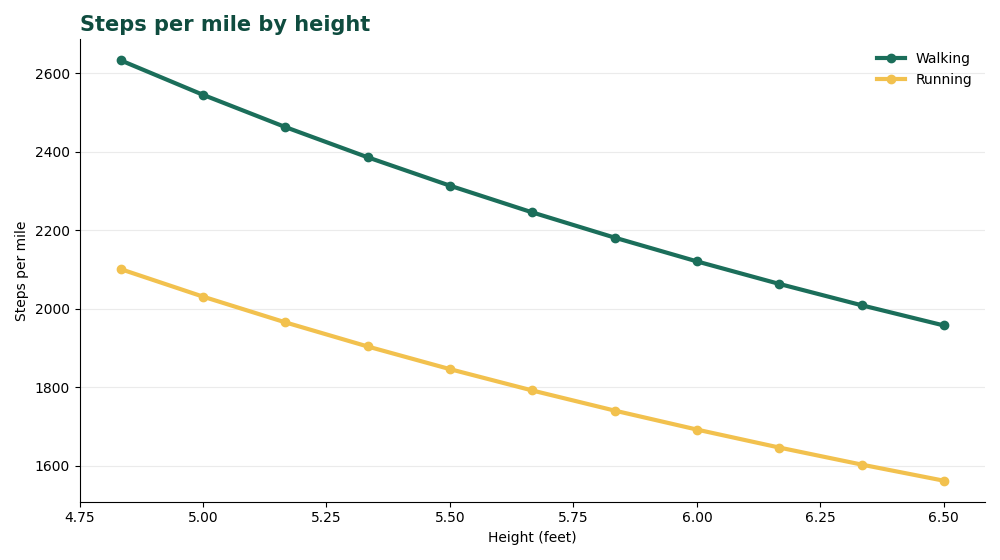
How to use this chart
- Find the row closest to your height.
- Read the steps per mile for your activity.
- Divide your step count by that number to get miles. For example, 9,000 walking steps at 5’6″ is 9,000 ÷ 2,313 = 3.89 miles.
Prefer automatic math? The steps per mile calculator tab does the same conversion and also shows kilometers.
Why steps per mile differ
Height and leg length
Longer legs swing through a bigger arc, which lengthens each step. That is why a 6’4″ walker needs about 2,008 steps for a mile while a 4’10” walker needs about 2,626.
Walking speed
Stride tends to lengthen as you speed up, so brisk walking uses somewhat fewer steps per mile than a stroll. The chart reflects a typical, comfortable pace.
Running
Running adds a flight phase, which stretches stride by about a quarter. The result is around 1,600 to 2,100 steps per mile instead of 2,000 to 2,600.
Terrain and footwear
Hills, sand, snow and uneven trails shorten the stride. Heavy boots or tiring legs can do the same. Your personal number may therefore be a little higher on a hike than on a track.
Customize the chart with a measured stride
If you know your stride length, the formula is steps per mile = 63,360 ÷ stride in inches. A 30-inch stride gives 2,112 steps per mile; a 26-inch stride gives 2,437. To measure your stride, walk 20 steps and divide the total distance by 20, as described in the stride length guide.
Using the numbers with your tracker
Fitness devices use a stride setting to convert steps into distance. If your tracker’s distance is consistently off, compare its steps-per-mile figure with this chart. Walking a measured quarter-mile and counting steps is a quick calibration test. For longer-term reference, see the how many steps in a mile guide.
Frequently asked questions
How many steps are in a mile for the average person?
Around 2,200 to 2,300 when walking at average height. The exact number depends on stride length, which depends mostly on height.
Is steps per mile the same for men and women?
Not exactly. Differences in height are the main cause. Taller people take fewer steps, whatever their sex.
How many steps is a kilometer?
Roughly 1,250 to 1,600 walking steps depending on height. The chart lists steps per kilometer for each row.
Does running always take fewer steps per mile?
Yes, for a given person running uses fewer steps per mile than walking because the stride is longer.
Figures are estimates. For a personalized result use the steps to miles calculator.
Related guides
Try the free steps to miles calculator for your own height and stride.